
Molybdenum Disilicide Heating Elements
Molybdenum disilicide heating elements are advanced high temperature heating elements designed for a variety of industrial applications.
Please get in touch to find out about molybdenum disilicide heating elements that suit your application.
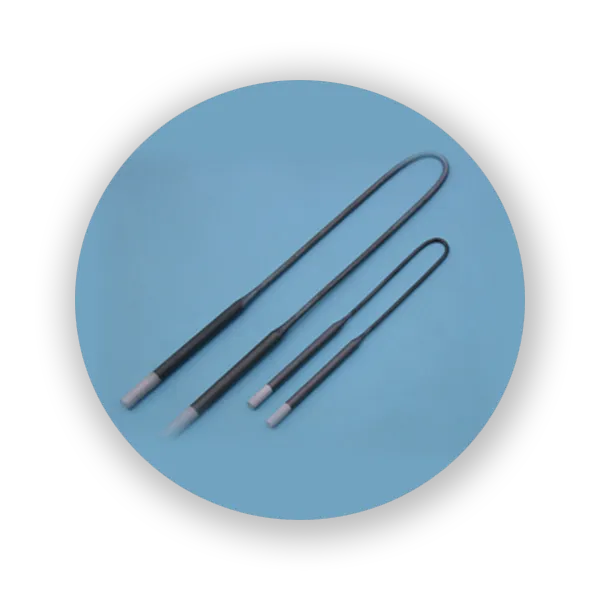
Molybdenum disilicide heating elements for your application
Manufactured from high purity molybdenum powder and silicon powder to form the compound molybdenum disilicide (MoSi2), these elements can operate effectively at temperatures reaching up to 1800°C, making them suitable for processes in ceramics, glass, metallurgy, and semiconductor industries.
One of the key benefits of MoSi2 heating elements is their outstanding resistance to oxidation. They form a protective silica layer during operation, which enhances their durability and extends their lifespan, significantly reducing maintenance needs and operational costs. This feature allows them to perform reliably even in challenging environments.
MoSi2 elements provide excellent thermal uniformity, ensuring consistent heating across the entire surface. This uniform heat distribution minimizes hot spots, leading to improved product quality and increased efficiency in manufacturing processes.
Features of Molybdenum Disilicide (MoSi2) Heating Elements
Molybdenum Disilicide (MoSi2) heating elements are available in various shapes and sizes, allowing for easy integration into different furnace designs and systems.
Typical Shapes:
U, W, L, and S, with bends in the cold end if required
Typical Element Diameters:
3/6, 4/9, 6/12 and 9/18
Request a Quote
Download MoSi Heating Element form, fill in your element dimentions and submit your form to sales@wintechnologies.com.au to request a custom quote.
Get In Touch
Have a question or need a tailored solution? Get in touch with our team we’re here to help.

Frequently Asked Questions
What are Molybdenum Disilicide (MoSi2) Heating Elements?
Molybdenum disilicide (MoSi2) heating elements are advanced high temperature electrical heating components used in industrial furnaces and kilns. Manufactured from high-purity molybdenum and silicon powders, these elements form the MoSi2 compound, enabling reliable operation at temperatures up to 1,800°C. MoSi2 heating elements are widely used in industries such as ceramics, glass production, metallurgy, and semiconductors due to their exceptional oxidation resistance, long lifespan, and ability to deliver uniform, efficient heating in demanding environments.
What are the benefits of MoSi2 heating elements?
MoSi2 heating elements offer multiple advantages over traditional high-temperature heating solutions:
- Can operate at extremely high temperatures up to 1,800°C
- Outstanding oxidation resistance due to the formation of a protective silica layer
- Long-lasting and durable, reducing maintenance and operational costs
- Excellent thermal uniformity for consistent heating and reduced hot spots
- Suitable for harsh industrial environments, including glass, ceramics, and metallurgy
How are MoSi2 heating elements installed and used in furnaces?
What types and configurations of MoSi2 heating elements are available?
MoSi2 heating elements are available in multiple shapes and sizes to fit diverse industrial furnace applications:
- U shaped elements – common for compact furnace layouts
- W shaped elements – suitable for larger surface areas or multi-zone heating
- L shaped elements – for corner and edge installations
- S shaped elements – used for specialized layouts or custom applications
- Custom bends – including bends in the cold ends for easier connection
- Typical element diameters – 3/6, 4/9, 6/12, and 9/18 mm